Laboratory
of Experimental High Energy Physics
Konstantin A. Goulianos
Professor
Experimental High-Energy Physics is the study of the basic constituents
of matter and their interactions. In a typical experiment, particles like
protons or electrons are accelerated to very high energies and brought
into head-on collision, creating a variety of other particles which do
not normally exist in nature. Detailed studies of this `particle zoo' have
revealed an inner order which is amazing in its simplicity: matter in all
its forms, from stars to living organisms, is made up of six quarks and
six leptons interacting among themselves by exchanging gluons, photons,
or W and Z particles, following strict rules coded into our current theoretical
framework, the Standard Model. 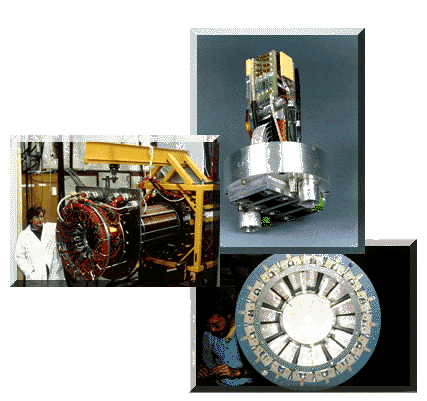
Founded in 1970, our Laboratory has made substantial contributions
that helped establish the Standard Model as the premier theory of elementary
particle physics. Our experiments at the Intersecting Storage Rings at
CERN were among the first to provide evidence for the existence of quarks
through the measurement of high transverse momentum particle production;
in experiments at the Brookhaven National Laboratory we discovered and
measured the rate of neutrino-proton elastic scattering, an example of
the neautral current interactions predicted by and essential to the foundation
of the Standard Model; and our experiments at the Fermilab Tevatron proton-antiproton
collider discovered the top quark. These experiments have lead to over
300 publications in refereed journals.
The discovery of the top quark was made by the CDF and D0
Collaborations, each consisting of about 500 physicists from 50 institutions.
Our group is a member of CDF. The experiment was conducted at the
Fermilab Tevatron proton-antiproton collider, in which counter-rotating
beams of protons and antiprotons were accelerated to energies of 900 billion
electron volts before brought into collision. About 60 particles were produced
in each collision, but only one in a trillion collisions contained a top-antitop
pair. The particles were detected by an assembly of particle detectors
weighing over 2,000 tons and employing 100,000 electronic channels. The
data used for the discovery of the top quark were collected over a period
of 4 years. The same data were used for a large number of other physics
measurements and discoveries. Our group made major contributions in the
areas of direct photon, jet, top and diffractive physics.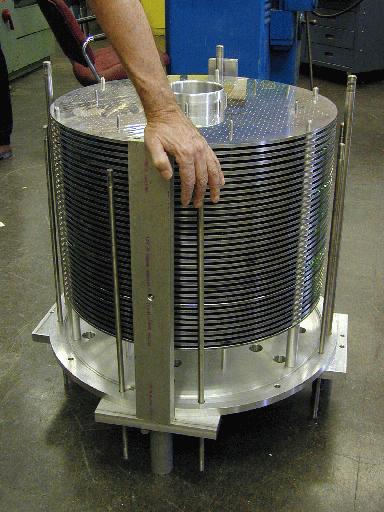
Despite its phenomenal success, the Standard Model is far from being
the theory of everything. Among other shortcomings, it does not provide
an explanation for the large disparity among quark masses, does not incorporate
gravity, and has little, if anything, to say about the dark matter and
the dark energy that make up most of the Universe. The ultimate theory,
the `DNA of Nature', is still at large. Searches for the Higgs field and
its associated quanta, which could explain quark masses, as well as for
Supersymmetry and for extra dimensions, ideas that could accomodate gravity,
have been performed on the existing CDF data, but resulted only
in placing limits on the relevant theoretical parameters. For a discovery
in these areas, more data are needed and of better quality. For this purpose,
both the Tevatron accelerator and CDF and D0 detectors have
been upgraded, and a new run has started at Fermilab scheduled to deliver
a 20-fold data set by the year 2007.
Our interest in the new CDF run is in the areas of the Higgs
search, studies of top quark and jet production relevant to physics beyond
the Standard Model, and understanding diffractive phenomena. The latter,
involving both perturbative and non-perturbative Quantum Chromo-Dynamics
(QCD), provide an arena in which non-perturbative approaches to QCD can
be tested. Our contributions to the CDF upgrade include the shower-maximum
detector of the plug upgrade calorimeter and an assembly of forward detectors
specially designed for the diffractive program. Armed with a state of the
art accelerator and detector, we look forward to unraveling the code that
produces the diversity and beauty in our Universe. Understanding this code
is the reward we seek in our research.